Table of Contents
Dune
Buggy's
Family
Racing
Resume
Sandrailing
Volkswagens
News
CNN
KGW.com
Periodicals
VW
Magazine Online
HOT VWs
Home
Last updated:
11/09/00
dean@vdubn.com
Advertisements:

|
Measuring
for Cylinder Spacers/Checking Deck Height

- What is Deck Height?
- Deck height is the amount of space between the top of the
piston and the top of the cylinder. This area combined with the volume of the
combustion chamber in the cylinder head, is what determines the compression ratio of your
engine. With stroker engines, you almost always need to use cylinder spacers as
opposed to cylinder shims to create the required deck height needed for your compression
ratio. The difference between cylinder shims and spacers, is that cylinder spacers
need to be machined by someone like RIMCO, whereas you can buy cylinder shims at almost
any VW Parts house. Also, cylinder spacers cost about $40 more than cylinder
shims. Cylinder spacers provide a more stable foundation for the cylinders to seat
against the case, and are the preferred method over cylinder shims.
-
- Tools Needs
- The following tools are needed to measure the deck height:
- Dial Caliper with depth gauge
- Dial Indicator
- Calculator
- Procedure
- We will use my situation as an example to show the procedure
used to find out the deck height required for my engine. First, I need to decide
what compression ratio I want to run in my engine. I decide to run 10:1 since I have
a sandrail engine that won't have any problems staying cool and since I know I will be
running Aviation fuel. Once I make this decision, I need to measure what my current
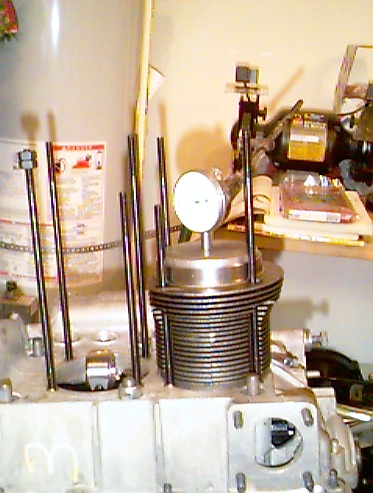
deck height is without any shims or spacers. To do this, I install the piston and
cylinder on my short block, removing the piston rings first, then I attach the dial
indicator to one of the head studs and rotate the engine to find Top Dead Center (TDC) of
the piston (see the image). TDC is located once the dial indicator shows the top of
the stroke.

-
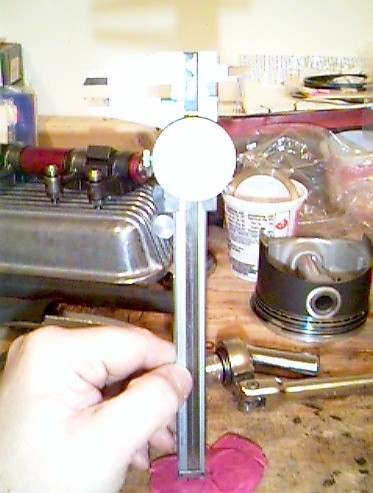
- Once I found TDC, I use my Dial Calipers and determine how
much negative deck height I currently have. I have negative deck height, becuase of
the 82mm stroke, and the lengthened 5.6 inch connecting rods. Look at the following
image that shows how I checked for the negative deck height.

-
- This measurement showed that I had .200 inch negative deck
height. After doing some calculations, I determined that I need an overall positive
deck height of .060 inches to get my desired 10:1 compression ratio, so that means that my
cylinder spacer needs to be .260 inches thick (.200 + .060 = .260). With .060 deck
height, my compression ratio will be 9.8:1, pretty close to 10:1. If you have Excel 97,
you can use my Engine Calculator to figure out your
compression ratio, engine displacement, etc.
-
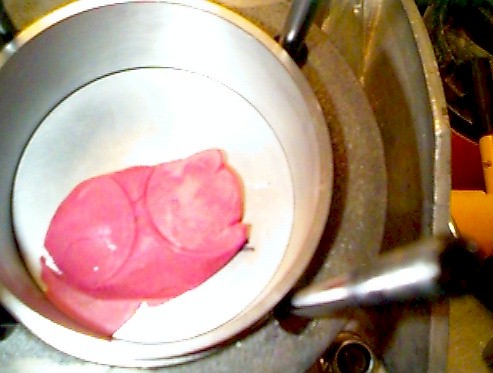
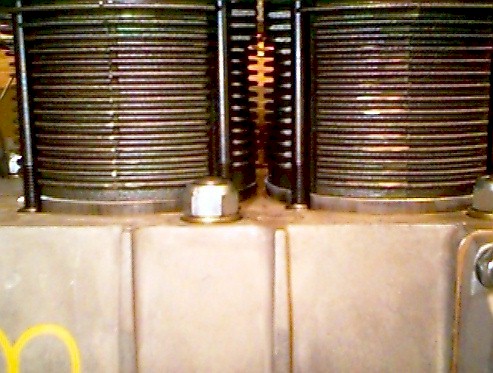
- Now that I have received the .260 inch spacers, I put
modelling putty on the piston to check for valve-to-piston
clearance. I installed one piston and cylinder, with the rings removed, and the
other cylinder, without the piston, so that I could bolt the head onto the engine (see
image).
 
-
- After bolting everything together, I rotated the engine at
least through 2 full rotations of the crankshaft, this makes sure that you have opened
both the Intake and exhaust valves completely. I then removed the head and inspected
the modelling clay to make sure there was adequate clearance (see the image).


|
|